Showing posts with label tale. Show all posts

Friday, May 20, 2011

Forts Across the American West
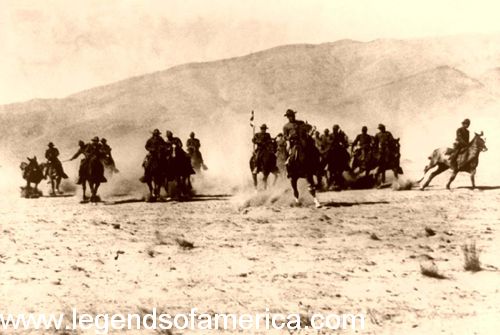
The forts of the American West varied in type from military posts, to fortresses established by fur trading companies, to private enterprises built solely to protect the pioneers within.

Most often when we think of Old West forts, we imagine a high stockade type wall of sharpened logs that surround a number of buildings. Inside these walls are hardy pioneers and soldiers, valiantly defending themselves from hostile Indians on the outside. Though western films have perpetuated this idea, and sometimesforts were built in a stockade type manner, the purpose and style offorts varied widely and this "typical" scenario was the exception rather than the rule.

Contrary to the myths perpetuated by western films, most militaryforts of the American West were not established to protect the settlers from Indians; rather, they were built to maintain peaceamong the tribes, as well as between Native Americans and white emigrants.

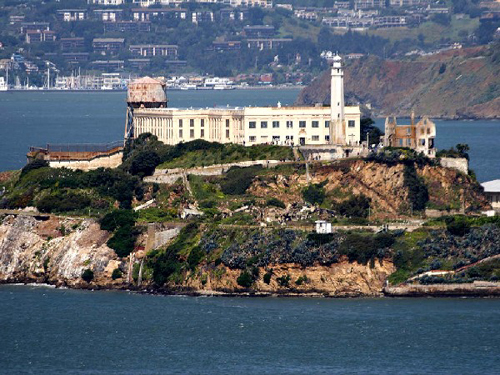
Alcatraz Island
Many people are not aware that Alcatraz was a fort
 before it became a Penitentiary. Photo by
John Sullivan, March, 2005.
This image available for photographic prints
 and downloads HERE!
U.S. CavalryFurthermore, they were seldom solidly constructed stockades with numerous permanent buildings. Sometimes, they were little more than a couple of blockhouses. Other types of fortifications were constructed by traders to protect their businesses and by settlers to protect their homes.
As more and more settlers moved west in the 19th century Army posts were established on the basis of anticipated use, sometimes to keep the Indian tribes from waging war with each other and at other times, to keep white settlers from encroaching upon native lands.
It was generally only when white settlers insisted on encroaching upon native lands, especially during the many gold and silver rushes, that the Indians retaliated. Only then did the forts’ primary purpose change to protecting the settlers. As westward expansion continued, threatening the Indian's livelihood, war between the whites and Indiansintensified, resulting in the push of Native Americans onto reservations. Once the Indianswere placed on reservations, some forts served as Indian agencies and distribution points for annuities given to tribes under treaty agreements.
When the many trails began to open such, as the Santa Fe Trail in the 1820’s and theOregon Trail in the 1840’s, traders and pioneers often met with not only, opposition from the tribes, but also, by road agents interested in relieving them of their money or their goods. In response, more forts were established to protect commerce along the trails.
When establishing a new fort, the soldiers would sometimes occupy buildings already established, but more often, were required to construct the new fort from materials available in the area. In forested areas, wood was usually used; adobe in the desert, and stone, where available. The typical frontier fort consisted of officers' quarters, barracks, stables, storehouses, and headquarters buildings, grouped around a central parade ground. Mostforts did not have walls surrounding them because attacks were generally unlikely.
Many army posts were referred to as "camps,” when there were only a few people assigned to the location or when the site was temporary. To be considered a "fort,” a full contingent of troops had to be permanently assigned to it. Both forts and camps were utilized by the U.S. Army during the Frontier Campaigns.
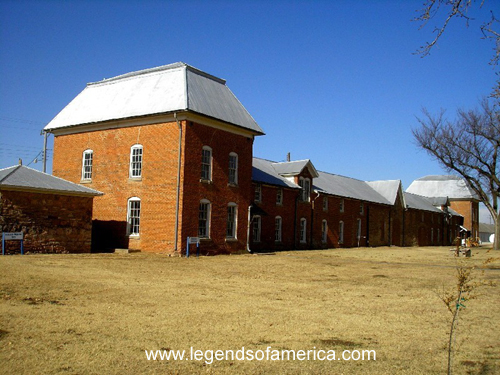
Fort El Reno, Oklahoma Commisary and Weapons Magazine, November,
2005, Kathy Weiser. This image available for photographic prints and
 downloads HERE!

Reacting to the quickly changing needs of the vast west, the Army would set up a post and then abandon it when no longer needed.
Though it was not the original intent to establish militaryforts to fight the Indian Wars, this changed when the U.S. government failed to protect tribal territorial rights and uphold treaties. Increasingly upset with treaty violations and travelers, settlers, and railroad crews encroaching on their lands, the Indians were retaliating in full force by the mid-1800s.
As a result the U.S. Government began a series of frontier campaigns to "tame” the Indians, force them on to reservations, and convert them to "civilized” life.

For the soldier, life was difficult and often monotonous at these many frontier outposts. The vast majority of recruits saw little or no combat and spent their time doing manual labor. Many forts were so isolated there were no nearby towns for single enlisted men to relieve the monotony or meet women. The normal "dull existence” of frontier life was too much for many of the troops and desertion rates were high.

Today, many of these Old West forts have been preserved, restored or rebuilt as monuments to our heritage and can still be seen as museums and national or state parks.


© Kathy Weiser/Legends of America, updated January, 2011.


Also See:


Fort Verde, Arizona

See my great buy's deals4all.yolasite.com

Friday, February 4, 2011

The Sand Creek Massacre Great Places for metal detectors!!!

Sand Creek Massacre


Painting of the attack on Sand Creek, courtesy the Colorado Historical Society


The Sand Creek Massacre, occurring on November 29, 1864, was one of the most infamous incidents of the Indian Wars. Initially reported in the press as a victory against a bravely fought defense by the Cheyenne, later eyewitness testimony conflicted with these reports, resulting in a military and two Congressional investigations into the events.
Starting in the 1850’s, the gold and silver rush in the Rocky Mountains brought thousands of white settlers into the mountains and the surrounding foothills. Dislocating and angering the Cheyennes and Arapahos who lived on the land, the Pike's Peak Gold Rush in 1858 brought the tension to a boiling point.

Washington, December 20, 1864

"The affair at Fort Lyon, Colorado, in which Colonel Chivington destroyed a large Indian village, and all its inhabitants, is to be made the subject of congressional investigation. Letters received from high officals in Colorado say that the Indians were killed after surrendering, and that a large proportion of them were women and children."
The Indians soon began to attack wagon trains, mining camps and stagecoach lines, a practice that increased during the Civil War, when the number of soldiers in the area was greatly decreased. Soon, this led to what became known as the Colorado War of 1864-1865.
As the violence between the Native Americans and the miners continued to increase, territorial governor John Evans sent a Voluntary Militia commander by the name of Colonel John Chivington to quiet the Indians. Chivington, though once a member of the clergy, his compassion did not extend to the Indians and his desires to extinguish them all was well known.
In the spring of 1864, while the Civil War raged in the east, Chivington launched a campaign of violence against the Cheyenne and their allies, his troops attacking any and all Indiansand razing their villages. The Cheyenne, joined by neighboring Arapaho, Sioux, Comanche, and Kiowa in both Colorado and Kansas, went on the defensive warpath.
Soon, Evans and Chivington reinforced their militia, raising the Third Colorado Cavalry of short-term volunteers who referred to themselves as the "Hundred Dazers." After a summer of scattered small raids and clashes, the Cheyennes and Arapahos were ready for peace, and as a result, the Indian representatives met with Evans and Chivington at Camp Weld outside of Denver on September 28, 1864. Though no treaties were signed, the Indiansbelieved that by reporting and camping near army posts, they would be declaring peace and accepting sanctuary. 
However on the day of the "peace talks” Chivington received a telegram from General Samuel Curtis (his superior officer) informing him that "I want no peace till the Indians suffer more...No peace must be made without my directions."
Unaware of Curtis's telegram, Black Kettle and some 550 Cheyennes and Arapahos, having made their peace, traveled south to set up camp on Sand Creek under the promised protection of Fort Lyon. Those who remained opposed to the agreement headed North to join the Sioux.
Knowing that the Indians had surrendered, Chivington led his 700 troops, many of them drinking heavily, to Sand Creek and positioned them, along with their four howitzers, around the Indian village. The ever trusting Black Kettle raised both an American and a white flag of peace over his tepee.

However, Chivington ignored the symbol of peace and surrender, raising his arm for attack. An easy victory at hand, cannons and rifles began to pound upon the camp as the Indians scattered in panic. The frenzied soldiers began to charge, hunting down men, women, and children, shooting them unmercifully. A few warriors managed to fight back allowing some members of the camp to escape across the stream.
One man, Silas Soule, a Massachusetts abolitionist, refused to follow Colonel Chivington's orders. He did not allow his cavalry company to fire into the crowd.
The troops kept up their indiscriminate assault for most of the day, during which numerous atrocities were committed. One lieutenant was said to have killed and scalped three women and five children who had surrendered and were screaming for mercy. Finally breaking off their attack they returned to the camp killing all the wounded they could find before mutilating and scalping the dead, including pregnant women, children and babies. They then plundered the teepees and divided up theIndians' horse herd before leaving
When the attack was over, as many as 150 Indians lay dead, most of which were old men, women and children. In the meantime, the cavalry lost only 9 or ten men, with about three dozen wounded. Black Kettle and his wife followed the others up the stream bed, his wife being shot in the back and left for dead.
Black Kettle's wife, although shot nine times, somehow managed to survived the attack. The survivors, over half of whom were wounded, sought refuge in the camp of the Cheyenne Dog Warriors (who had remained opposed to the peace treaty) at Smokey Hill River. Many of the Indians joined the Dog Soldiers, deciding there could be no successful negotiations with the white men and were waging war against them. Indeed, the Sand Creek Massacre is cited as a critical cause of the Little Big Horn battle, as many Cheyenne warriors simply devoted their lives to war against the US.
The Colorado volunteers returned to Denver, exhibiting their scalps, to receive a hero's welcome. Initially the battle was reported in the press as a victory against a bravely-fought defense by the Cheyenne. Within weeks, however, eyewitnesses came forward offering conflicting testimony, leading to a military investigation and two Congressional investigations into the events. Silas Soule was eager to testify against Chivington. However, after he testified, Soule was murdered by Charles W. Squires, believed to have been ordered by Chivington.
As the details came out, the US public was shocked by the brutality of the massacre. The congressional investigation subsequently determined the crime to be a "sedulously and carefully planed massacre." When asked at the military inquiry why children had been killed, one of the soldiers quoted Chivington as saying, "nits make lice." Though Chivington was denounced in the investigation and forced to resign, neither he nor anyone else was ever brought to justice for the massacre.
While the Sand Creek Massacre outraged easterners, it seemed to please many people in Colorado Territory. Chivington later appeared on a Denver stage where he regaled delighted audiences with his war stories and displayed 100 Indian scalps, including the pubic hairs of women.
As word of the massacre spread among the Indians of the southern and northern plains, their resolve to resist white encroachment stiffened. An avenging wildfire swept the land and peace returned only after a quarter of a century.
Through the years, the area of the Sand Creek Massacre has continued to be visited and commemorated. An aging John Chivington returned to the area in 1887, and in 1908 Veterans of the Colorado Regiments planned a reunion at the site. In August of 1950 the Colorado Historical Society assisted local residents and the Eads and Lamar Chambers of Commerce in placing a marker atop the bluff at the Dawson South Bend. Sand Creek descendants remain active in tribal communities inMontana, Oklahoma, and Wyoming – and Council Representatives continue to work alongside the National Park Service.  
The massacre site was authorized as a National Historic site on August, 2, 2005. However, it will not be established until theNational Park Service acquires enough land to provide for the preservation, commemoration, and interpretation of the Sand Creek Massacre and is not yet open to the public.

© Kathy Weiser/Legends of America, updated August, 2010.

Contact Information:
P.O. Box 249
Eads, 
Colorado 81036 
719-438-5916


Legends of America Lodging
Book your lodging right HERE online


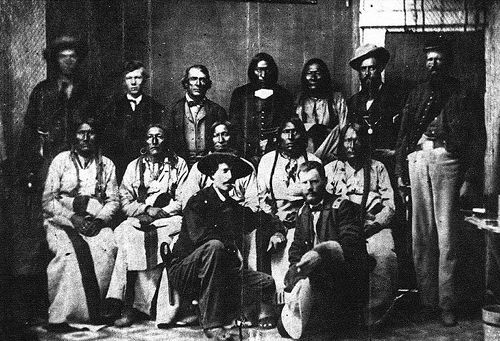
Camp Weld meeting
Black Kettle (seated center) and other Cheyenne chiefs conclude successful peace talks with Major Edward W. Wynkoop (kneeling with hat) at Fort Weld, Colorado, in September 1864. Based on the promises made at this meeting, Black Kettle led his band back to the Sand Creek reservation, where they were massacred in late November. Photo courtesy National Archives.

Native American Vintage PhotographsNative American Photo Prints  - Vintage photographs of famous chiefs, heroes, and Indian life in the 19th century.


Hope You Enjoyed The Story !
Please take a look at these other websites Gold Seekers Tools And Prospectors Tools

Wednesday, January 12, 2011

Treasure Hunting Code of Ethics

Treasure Hunter - Code of Ethics

Treasure Hunting MapResponsible hunting will keep the hobby alive for everyone else! Please follow the Treasure Hunter's Code of Ethics so that all of us can continue to enjoy this enjoyable hobby and perhaps, even get lucky and find our fortunes!.

  1. I will respect private property and will do no treasure hunting without the property owner's permission. 
  2. I will fill in all holes I dig.
  3. I will not damage natural resources, wildlife habitats, or any private property.
  4. I will use thoughtfulness, consideration, and courtesy at all times.
  5. I will build fires in designated or safe places only.
  6. I will leave gates as found.
  7. I will remove and properly dispose of any trash that I find.
  8. I will not litter.
  9. I will not destroy property, buildings, or what is left of ghost towns and deserted structures.
  10. I will not tamper with signs, structural facilities, or equipment.
  11. And, finally, the most important one of all -- I will have fun!!
If we all follow these simple rules while metal detecting or treasure hunting, we will go a long way to keeping the public on our side in the fight to protect our rights.
 Hope you get some use from these tips! please check out my websites for any tools you may need 
And 

Cute video watch it !

GoAnimate.com: wealth 4 all dinner by mrhall909

Like it? Create your own at GoAnimate.com. It's free and fun!