| ||||||||||||||

I'm changing the theme of my blog from gold prospecting too seeking gold! Any type of gold in other words any way we can make enough money to buy Gold or Silver
Showing posts with label buried. Show all posts
Showing posts with label buried. Show all posts
Friday, May 6, 2011
CALIFORNIA LEGENDS Lost Chinese Cache Volcanoville


Thursday, April 7, 2011
More California Treasures Just Waiting To Be Found
Alameda County - With a posse on their tails in 1893, two banditsallegedly buried a cache of stolen loot near a brick kiln at Adams Point on Lake Merritt. When the lawmen caught up with the outlaws, one was killed and the other immediately arrested. The surviving outlaw died later died in prison. The ill-gotten treasure has never been found. Contra Costa County - Dr. John Marsh, a California pioneer who was sometimes referred to as California's first American doctor, was allegedly known to bury his money near his home nestled in the foothills of Mt. Diablo. | 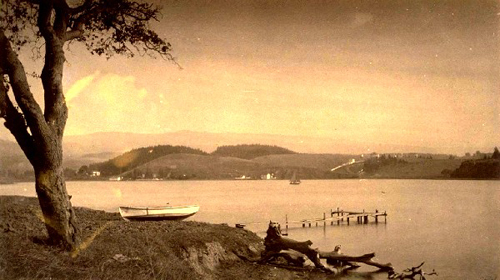 Lake Merritt from Adams Point, 1884, photo courtesy California Digital Archives. | ||||||||
| |||||||||
Saturday, March 26, 2011
Outlaws Steal Outlaw Loot

Loads of treasure are said to have been buried in southeast Arizona near an unknown peak that was once called Davis Mountain by the people who hid it there. This large cache was stolen from a smuggler train headed from Mexico. However, the original treasure was stolen from a bank vault in Monterey and a church in Matamoras, Mexico. The treasure included a cigar box full of diamonds, two statuary figures of pure gold -- one of the Virgin Mary and one of Jesus, sacks of gold and silver, thirty-nine bars of solid gold bullion and several rawhide bags of ninety thousand Mexican dollars.
Fittingly, the bandit smuggler train was robbed by outlaws while traveling through Skeleton Canyon. After robbing the smuggler train, the outlaws buried the loot on what they called Davis Mountain. Although this mountain does not exist today on any Arizona map, one of the bandits gave intricate directions to the treasure before he died. Why these outlaws did not return for the treasure or what became of them is unknown.
The dying bandit’s directions were:
Head west across rolling plains to Davis Mountain, a bald, rounded granite dome visible for miles. With binoculars, it is said that you can see New Mexico from the peak of this mountain and old Sugar-Loaf can be seen standing boldly up against the sky.
Once you have arrived at Davis Mountain, continue west for 1 to 1 ½ miles, until you spot a canyon. The east wall of the canyon has wooded hills, while the west wall is sheer rock precipice.
The creek that flows through this canyon plunges over a ledge in a small cataract approximately ten feet high and Silver Spring flows into the canyon on its west end. Near this spring is a tall juniper tree where, at its foot, is a grave marked by slabs of stone. Five hundred dollars in gold is allegedly buried in a tin can at the head of the grave.

Sugar Loaf Mesa courtesy New Mexico Mosaics
Up the canyon and south of Silver Springs approximately 1 to 1 and 1/3 miles is Gum Spring. Between the two springs, lying in the scattered brush, are the remains of a burned out wagon. This wagon is located on the west side of the canyon where it curves inward to form a shallow cove. At the deepest part of this cove lies a stone marker which is three feet high, squarely shaped, and one foot thick. On the east face of this marker is carved two crosses. After locating the stone, face Davis Mountain and step twenty paces. This is where the treasure is said to be buried.
© Kathy Weiser/Legends of America, updated July, 2010.
Saturday, March 19, 2011
Lost Treasures of Northern California
As in many places of the American West, the friction between the scores of men entering California during its Gold Rush days and the Indians was often bitter. Weary of the white men continuing to encroach upon their lands, the danger to travelers was very high when entering the California from the northeast. As the California Trail proceeded south into the SacramentoValley on the Pit River route, wagon trains and travelers were often ambushed by the natives. Bloody Springs, at the lower end of Spring Gulch, was the scene of numerous attacks, hence its name. Smaller groups were often wiped out. | 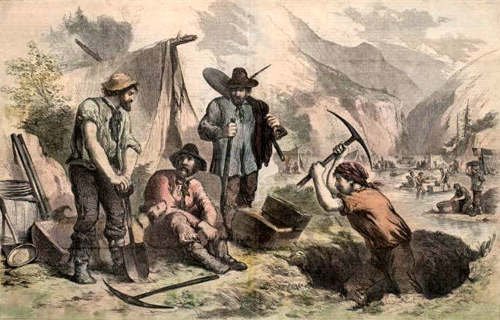 Engraving of California gold miners, John Andrew, mid 1800's. | |
| ||
Tuesday, March 15, 2011
UTAH LEGENDS Winter Quarters - Hidden Loot in a Ghost Town
| ||||||
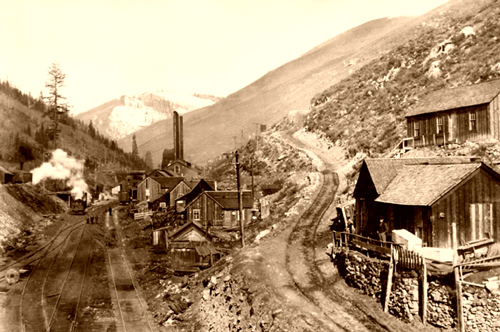
Phil Beard, John Nelson and I started No. 1 tunnel and drove the first hundred feet into the hillside. Later, thousands of tons of coal were hauled out of this entry. I helped dig from the five-foot vein, the first load of coal ever shipped out of the valley,” so said Matson in an Aug. 23, 1928 issue of The Sun newspaper, published at Price." The high mountain ghost town in extreme northwestern Carbon County, became known as Winter Quarters because John Nelson and Abram Taylor wintered there in 1875 to hold the claim they had filed. Two years later a group of men from Sanpete County came over the mountain to begin the town and continually work the mine. They intended to leave before winter, but an early snowstorm trapped the men. When their supplies ran out in February 1878, they the walked out to the north, eventually reaching the town of Tucker (now a ghost town and rest stop) in Spanish Fork Canyon. When the great tonnage of coal in the mountain was known, more people began moving into the burgeoning town. As more and more coal was mined, the need for a railroad became apparent. Some of the residents got together and bought out a dry goods firm in the east and paid railroad workers with clothing and fabrics. That old railroad bed is now a dirt road leading from the Tucker rest area on US-6 up the mountain onto what is known today as Skyline Drive and then down into Pleasant Valley. The railroad became known as the Calico Line. May Day, 1900, started out with a clear sun shinning up the valley into the town as 303 miners headed up to the mine portal. This mine was considered one of the safest in the country and had been inspected by Gomer Thomas, state mine inspector, on March 8. But at 10:15 a.m. everyone in the mountain town felt the ground shake. Some people thought someone had fired off an explosion to celebrate Dewey Day. Soon, the horrible truth spread through the town like wildfire. A giant explosion had occurred in the mine. Mothers and daughters were seen hurrying toward the mine portal, "faces blanched with fear, hoping against hope that their loved ones in some way had escaped. Soon the realization came that the miners were caught – caught like rats in a trap with no chance of escape,” reported Charles Madsen in his account of the disaster.
| ||||||

Sunday, February 13, 2011
CALIFORNIA LEGENDS Rattlesnake Dick's Stolen Loot
Richard Barter, also known as Rattlesnake Dick and Dick Woods, was born in Quebec, Canada, the son of a British officer around 1833. Though little is known of his early history, he was said to have been a reckless sort of boy During California’s Gold Rush days, he migrated there in 1850, accompanied by an older brother and an old man who was some sort of relative. Settling in at Rattlesnake Bar, a small mining camp in Placer County, the brother and other man soon returned to Canada. But, Dick remained at the camp, working for other miners and doing a little prospecting on his own. However, Barter was unsuccessful in his quest for gold and soon decided to turn to a life of crime. He began with rustling horses but was as unsuccessful at that as he was at finding gold. In no time, he was arrested and sent to prison for two years. When he was released he formed a gang made up of brothers, Cyrus and George Skinner, along with several others. In 1856, Barter learned from a drunken mining engineer that large gold shipments were being sent down Trinity Mountain from the Yreka and Klamath River Mines. Barter sent George Skinner and three others to intercept the gold shipment, which was packed on mules. George and the other bandits stopped the mule train outside of Nevada City, California holding guns on the muleskinners. Meekly the men turned over $80,600 in gold bullion to Skinner and his men, without a shot being fired. The bandits then made off with the shipment to keep a rendezvous at Folsom with Barterand Cy Skinner. However, George Skinner found it next to impossible to take the heavy gold shipment down the mountain passes without fresh mules. Soon, he split up the gold shipment burying half of it in the mountains. Making their way to Auburn, the outlaws were soon intercepted by a Wells Fargo posse and gunfight ensued. In the melee, George Skinner was killed and his confederates fled. The lawmen recovered $40,600 of the stolen loot and though they searched diligently, they failed to find the remaining $40,000. In the meantime, Rattlesnake Dick and Cy Skinner weren’t at the rendezvous point in Folsom, as they had just been jailed for stealing mules. When they were released, Barterimmediately sought out George Skinner to obtain his share of the gold shipment, only to find that Skinner had been killed. Cy Skinner and Barter spent the next several weeks trying to find the buried gold before they finally gave up. Both men soon went back to robbing stagecoaches but their luck soon ran out. On July 11, 1859, Sheriff J. Boggs trapped Barter and Skinner in a mountain pass near Auburn,California. Boggs fired a shot right into the heart of Rattlesnake Dick, killing him instantly.Skinner was wounded, but lived to be taken into custody and given a long prison sentence. The treasure has never been recovered and is said to be somewhere on the slope of Trinity Mountain, said to have been buried about 12 miles south of the hold up point. © Kathy Weiser/Legends of America, updated October, 2010 | 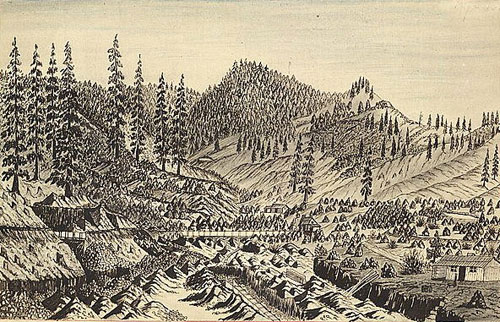 |
Saturday, January 29, 2011
More California Treasures Just Waiting To Be Found
Alameda County - With a posse on their tails in 1893, two banditsallegedly buried a cache of stolen loot near a brick kiln at Adams Point on Lake Merritt. When the lawmen caught up with the outlaws, one was killed and the other immediately arrested. The surviving outlaw died later died in prison. The ill-gotten treasure has never been found. Contra Costa County - Dr. John Marsh, a California pioneer who was sometimes referred to as California's first American doctor, was allegedly known to bury his money near his home nestled in the foothills of Mt. Diablo. | Lake Merritt from Adams Point, 1884, photo courtesy California Digital Archives. | ||||||||
| |||||||||
Subscribe to:
Posts (Atom)