Showing posts with label wells fargo. Show all posts

Saturday, March 26, 2011

Outlaws Steal Outlaw Loot


Wagon Train
Loads of treasure are said to have been buried in southeast Arizona near an unknown peak that was once called Davis Mountain by the people who hid it there. This large cache was stolen from a smuggler train headed from Mexico. However, the original treasure was stolen from a bank vault in Monterey and a church in Matamoras, Mexico. The treasure included a cigar box full of diamonds, two statuary figures of pure gold -- one of the Virgin Mary and one of Jesus, sacks of gold and silver, thirty-nine bars of solid gold bullion and several rawhide bags of ninety thousand Mexican dollars.

Fittingly, the bandit smuggler train was robbed by outlaws while traveling through Skeleton Canyon. After robbing the smuggler train, the outlaws buried the loot on what they called Davis Mountain. Although this mountain does not exist today on any Arizona map, one of the bandits gave intricate directions to the treasure before he died. Why these outlaws did not return for the treasure or what became of them is unknown.
The dying bandit’s directions were:
Head west across rolling plains to Davis Mountain, a bald, rounded granite dome visible for miles. With binoculars, it is said that you can see New Mexico from the peak of this mountain and old Sugar-Loaf can be seen standing boldly up against the sky.
Once you have arrived at Davis Mountain, continue west for 1 to 1 ½ miles, until you spot a canyon.  The east wall of the canyon has wooded hills, while the west wall is sheer rock precipice.

The creek that flows through this canyon plunges over a ledge in a small cataract approximately ten feet high and Silver Spring flows into the canyon on its west end. Near this spring is a tall juniper tree where, at its foot, is a grave marked by slabs of stone. Five hundred dollars in gold is allegedly buried in a tin can at the head of the grave.

Sugar Loaf Mesa
Sugar Loaf Mesa courtesy New Mexico Mosaics
Up the canyon and south of Silver Springs approximately 1 to 1 and 1/3 miles is Gum Spring. Between the two springs, lying in the scattered brush, are the remains of a burned out wagon. This wagon is located on the west side of the canyon where it curves inward to form a shallow cove. At the deepest part of this cove lies a stone marker which is three feet high, squarely shaped, and one foot thick. On the east face of this marker is carved two crosses. After locating the stone, face Davis Mountain and step twenty paces. This is where the treasure is said to be buried.


© Kathy Weiser/Legends of America, updated July, 2010.

Sunday, February 13, 2011

CALIFORNIA LEGENDS Rattlesnake Dick's Stolen Loot


Richard Barter, also known as Rattlesnake Dick and Dick Woods, was born in Quebec, Canada, the son of a British officer around 1833. Though little is known of his early history, he was said to have been a reckless sort of boy

During California’s Gold Rush days, he migrated there in 1850, accompanied by an older brother and an old man who was some sort of relative. Settling in at Rattlesnake Bar, a small mining camp in Placer County, the brother and other man soon returned to Canada. But, Dick remained at the camp, working for other miners and doing a little prospecting on his own.

However, Barter was unsuccessful in his quest for gold and soon decided to turn to a life of crime. He began with rustling horses but was as unsuccessful at that as he was at finding gold. In no time, he was arrested and sent to prison for two years.

When he was released he formed a gang made up of  brothers, Cyrus and George Skinner, along with several others. In 1856, Barter learned from a drunken mining engineer that large gold shipments were being sent down Trinity Mountain from the Yreka and Klamath River Mines.

Barter sent George Skinner and three others to intercept the gold shipment, which was packed on mules. George and the other bandits stopped the mule train outside of Nevada City, California holding guns on the muleskinners. Meekly the men turned over $80,600 in gold bullion to Skinner and his men, without a shot being fired.

The bandits then made off with the shipment to keep a rendezvous at Folsom with Barterand Cy Skinner. However, George Skinner found it next to impossible to take the heavy gold shipment down the mountain passes without fresh mules. Soon, he split up the gold shipment burying half of it in the mountains.

Making their way to Auburn, the outlaws were soon intercepted by a Wells Fargo posse and gunfight ensued. In the melee, George Skinner was killed and his confederates fled. The lawmen recovered $40,600 of the stolen loot and though they searched diligently, they failed to find the remaining $40,000.

In the meantime, Rattlesnake Dick and Cy Skinner weren’t at the rendezvous point in Folsom, as they had just been jailed for stealing mules. When they were released, Barterimmediately sought out George Skinner to obtain his share of the gold shipment, only to find that Skinner had been killed. Cy Skinner and Barter spent the next several weeks trying to find the buried gold before they finally gave up.

Both men soon went back to robbing stagecoaches but their luck soon ran out. On July 11, 1859, Sheriff J. Boggs trapped Barter and Skinner in a mountain pass near Auburn,California. Boggs fired a shot right into the heart of Rattlesnake Dick, killing him instantly.Skinner was wounded, but lived to be taken into custody and given a long prison sentence.

The treasure has never been recovered and is said to be somewhere on the slope of Trinity Mountain, said to have been buried about 12 miles south of the hold up point.


© Kathy Weiser/Legends of America, updated October, 2010


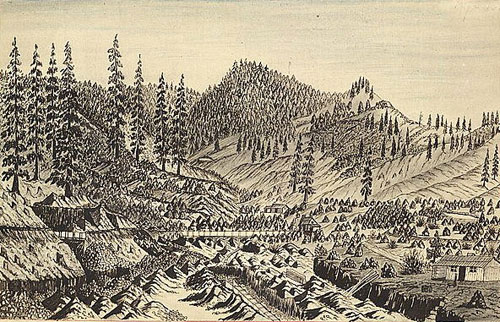
Yreka Mine, 1860

Tuesday, January 25, 2011

ARIZONA LEGENDS


Flagstaff Trading Post - Due the many robberies during the 1800s, one owner of an Indian trading post named Herman Wolf, got in the habit of burying his profits in cans and jars around the fences on his property. Operating the trading post for thirty years on the Little Colorado River between 1869-1899, his highly profitable business brought him tens of thousands of gold and silver coins over the years. These treasure troves are said to have numbered in the hundreds of thousands and his thirty year accumulationestimated at $250,000.

In 1901 twenty U.S. gold coins were found, and in 1966, a bucket of Mexican silver was discovered at the site. However, these two finds are but a small percentage of what was buried and the main cache remains to be found. The old store was located on the LittleColorado River River just off the California-Santa Fe Trail nearCanyon Diablo.

Flagstaff Arizona 1943
Ashurst Ranch - Long a go a man named William Ashurst owned a ranch about 25 miles southeast of Flagstaff. The ranch was located near a good spring, known as Ashurst Run. The rancher was said to have buried a number of five and ten pound cans filled with gold coins on his property. According to legend, this gold was never recovered after his death.

Rogers Lake - During the winter of 1881, outlaws Henry Corey and Ralph Gaines stole eight large gold bars from the Tip Top Mine near Gillette, Arizona. Each of these bars, which were three feet long and four inches wide, were buried near a cabin at Rogers Lake. The pair then headed to Flagstaff, where they relieved a stagecoach of $25,000 in gold and silver coins. Returning to the cabin with the treasure, they dug up the gold bars and placed these, along with the stagecoach loot, into large wooden kegs. Chipping a hole in the ice, they then lowered their stolen booty into the lake. Before long the sheriff learned that the outlaw pair was holed up at Rogers Lake and along with a posse, set out to capture them. Spying the approach of the lawmen, the bandits made a hasty retreat, leaving the treasurebehind. Later, Gaines would be killed in a brawl and Corey was arrested during a holdup near Globe, Arizona and sent to prison. When Corey was released 24 years later, he and a friend made repeated searches for the loot but it was never found. Corey died in 1936. During dry times throughout the year, the dry lakebed areas of this low level lake can be easily searched.

Morman Lake In 1879, four outlaws robbed a stage near Gila Bend, making off with $125,000 in gold coins and 22 gold bars stamped "AJO". The very next day, they robbed another stage near Stanwix Station where they made a haul of two chests which contained $140,000 in gold coins and $60,000 in currency.

The gang fled to the northeast into Tonto Basin, then turned to the northwest as a posse began to catch up with them. Before long the lawmen overtook the gang and the inevitable shoot-out occurred. Two of the outlaws were killed in the foray, but two others escaped toHolbrook.

The two outlaws holed up at Holbrook for a time waiting for things to cool off. While there, one of the outlaws was killed in a dispute over a poker game. His outlaw partner, Henry Tice, then killed the other gambler.

However, someone felt that justice was not yet done, and shot Tice, leaving no one to disclose the location of the hidden loot. The cache is believed to be somewhere around the cliffs between Morman Lake and Flagstaff and though many have looked, it has never been found.
© Kathy Weiser/Legends of America, February, 2010.

Hope you enjoyed the stories please take a minute to view my websites 

Cute video watch it !

GoAnimate.com: wealth 4 all dinner by mrhall909

Like it? Create your own at GoAnimate.com. It's free and fun!