Showing posts with label lost treasure. Show all posts

Friday, May 6, 2011

CALIFORNIA LEGENDS Lost Chinese Cache Volcanoville


By Anthony Belli

Forgotten now are the thousand or more places where much of El Dorado County’s history was written. In mining camps and towns such as… Hell Roaring Diggings, Loafer’s Hollow, Whiskey Flat, George’s Town, and Poverty Flat. The names of other camps frequently told you much about who was mining there… Chile Bar (Chileans), Kanakatown (Hawaiians), Frenchtown, Alabama Flat, Texas Bar, Cooley Mine (Chinese), Indian Diggings, Mormon Gulch, even Puritan Camp. Forever consigned to the records of time each of these camps had it’s own unique and often colorful history. One such place is the ghost town of Volcanoville where tales of it’s past includes mining, and buried treasures. 


Volcanoville, California
One of a few remaining abandoned buildings left standing in the ghost town of Volcanoville, photo by Anthony Belli.

It was here during the days of the California Gold Rush when the Volcanoville boasted a lively population of thousands, including a large Chinatown. In the cemetery, two headstones remain which speak of the town’s past. The tombstones tell of two 49ers interred here -- both youths had been murdered for their miner’s poke by Gold Rush highwaymen.

Located in northwest El Dorado County, Volcanoville sits just south of the Middle Fork of the American River. Today telephone poles along Volcanoville Road mark the edge of progress - stopping just short of the old town site where few old buildings stand in defiance of encroaching development.

It was during the mid-1870’s when Volcanoville saw a serious decline in mining as many quartz mines played out. With gold more difficult to find, anger and hate for all non-Anglos in the diggings became a hot subject. Most Chinese were now working in the larger cities in Northern
California, for those who remained in the Mother Lode they suffered the most since they represented competition to White miners. Such was the case in 1874 when Chinese miners discovered a 10 oz. pure gold nugget on their claim at the Cooley (Chinese) Mine in Volcanoville ....

One evening a group of miners gathered at a local saloon where their conversation turned towards the dreaded Chinese. With enough liquor, words quickly turned to action leading to the massacre of at least 15 Chinese that night. The Chinese miners were rounded up by the drunks and herded into a cabin. With the Chinese locked inside, the cabin was set a fire. Those who died in the inferno were only spared a bullet; those who ran from the flames and thick smoke were quickly gunned downed in flight. None survived.

While many Chinese were mining along the Middle Fork of the American River one group of 12 from Volcanoville was buried alive in a cave-in during the 1890’s. By the time aid reached the men they had died from suffocation.

Another story from Volcanoville tells of a wealthy Chinese store owner who ran a thriving general store. He sold out to another China man and himself returned to China. For years he remained in his homeland before returning to Volcanoville.

Chinese miners in Calfiornia, mid 1800's.
Chinese miners in California, mid 1800's.

He claimed he returned to retrieve a cache of gold he’d hidden years earlier. A major fire had destroyed much of the town in 1879 which left the older former store owner with no landmarks to guide him to his treasure. He returned several times over the next several years looking for his lost cache but never found it.

For years treasure hunters have sought to answer the question of the lost Chinese caches buried in and around Volcanoville.

Volcanoville was founded as a small trading post in 1851 but grew into a large prospering Gold Rush town by 1855. Other industry in the area included a steam driven sawmill and tannery at Mt. Gregory. Volcanoville became a voting prescient in 1854 and established it own Post Office in 1858.

 Mining became prosperous here again during the 1880’s and remained so through the 1890’s supporting a twenty-stamp mill. At that time the largest working quartz mine was the Josephine. As most of the town’s residents were employees of the Josephine Mine, in 1895 the Post Office changed the name of the town from Volcanoville to Josephine. The Josephine Post Office operated until discontinued in 1917. The town saw two devastating fires, the first in 1879 then again in 1907. All of the remaining original buildings to survive the 1879 fire were destroyed in the 1907 fire. A small community re-established itself here but the town never recovered.

Somewhere I once read that "25% of all the precious metals and gems ever recovered have become lost". It is true during the era when global transportation was provided by the great sailing ships of the day much treasure went down the result of accident, piracy, or violent storms. The next cause has been laid to natural disasters. Finally the remainder is credited to the individual who acquires wealth and buries it for safekeeping. For whatever reason, the owner of the cache is separated from his wealth and is never able to recover it. It is said that a dozen or more of these buried Chinese caches is connected to the history at Volcanoville.


Hope you enjoyed the story get your hunting supplies here -


Thursday, April 7, 2011

More California Treasures Just Waiting To Be Found


Alameda County - With a posse on their tails in 1893, two banditsallegedly buried a cache of stolen loot near a brick kiln at Adams Point on Lake Merritt. When the lawmen caught up with the outlaws, one was killed and the other immediately arrested. The surviving outlaw died later died in prison. The ill-gotten treasure has never been found.

Contra Costa County - Dr. John Marsh, a California pioneer who was sometimes referred to as California's first American doctor, was allegedly known to bury his money near his home nestled in the foothills of Mt. Diablo.

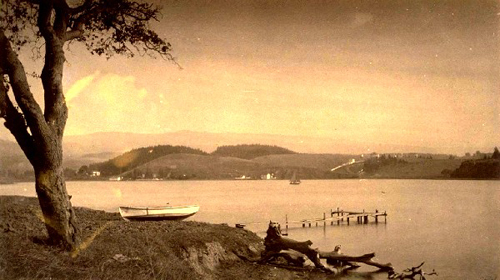
Lake Merritt, California, from Adams Point, 1884
Lake Merritt from Adams Point, 1884, photo

Marsh was murdered in 1856 while on his way home from Martinez, without ever telling anyone of the exact location of his hidden riches. The treasure tale today alleges that Marsh had hidden a cache of some $40,000 gold coins near his home or Marsh Creek, that bears his name. Currently plans are under way to develop the location into a CaliforniaState Park.


Another, even larger treasure is said to be buried along the beaches of the county. In 1901, the Selby Smelter at Vallejo Junction was busy refining ores that were shipped from a number of neighboring mining districts.  But, one employee by the name of John Winters, was "busy” at a different task -- that of removing gold bars, one at a time from the vault, and burying them on the beach near the water’s edge. Taking an estimated $283,000 in gold, Winters was finally caught and about $130,000 of the bars were recovered. However, more than $150,000 remained lost.

Humboldt County - In July of 1928, the small post office at Willow Creek was robbed by two outlaws that escaped with some $2,800. According to the story, the bandits buried the loot in one of two places and never returned to retrieve it. The first version of its location tells of the stolen cache being buried near the Cedar Flat Bridge that crosses Trinity River about four miles upriver from Burnt Ranch. The second location has the loot hidden at some point up New River Canyon on the first ranch above the mouth of New River.

Another stolen cache, taken by an employee of the San Francisco Mint in 1894, is said to be buried in Humbolt County. The thief was later captured and sent to prison for his crime but refused to reveal the exact location of the loot. The treasure, containing some 290 pounds of gold ingots, is thought to be buried at Shelter Cove near Point Delgado.

Inyo County - Near Scotty's Castle in Death Valley, some say that a hidden cache of gold coins, amounting to as much as $200,000, was buried by Walter Scott. "Scotty," as he was more familiarly known, was a flamboyant and outrageous character, and a known swindler and prospector. Though he did not build or own the castle that bears his name, he was closely associated with the man that did.

Kings County - In 1873, the small town of Kingston, California was a stopping place on the Overland Stage route between Stockton and Visalia, California. In December of 1873,Tiburcio Vasquez and outlaw band made a bold raid, robbing the entire village and holding 39 men hostage. When an alarm was raised , the bandits dashed to their horses and began to flee. However, in the ensuing melee, three of the outlaws were shot and killed and the man carrying the stolen loot was wounded.

Kingston, California, 1879
Kingston, California is gone today but was thriving in 1870, photo
Unable to reach a horse, the injured bandit escaped on foot and made his way across the Kings River. Though theoutlaw was pursued, neither he nor the loot could be found. Years later, a skeleton was discovered in the area and was thought to have been the injured bandit, but again the ill-gotten cache remained unrecovered.

By the 1890's the town of Kingston had totally been abandoned and is completely gone today. The site of the town is now a California Historical Landmark (#270), which can be found in Kingston Park in the city of Hanford.

Marin County - Not all lost treasures of California are related to the Gold Rush. During the wild and wooly days of Prohibition, a German whiskey smuggler named Carl Hause was doing a brisk business. Hause's operations were located on Point Reyes Peninsula at the edge of Drake's Inlet just south of Inverness. The whiskey smuggler was said to have buried approximately $500,000 in gold-backed currency somewhere between Inverness and the old Heims Ranch. However, the liquor entrepreneur would not live to retrieve his ill-gotten gains as he was found shot to death in his car. The currency has never been found.


Modoc County - Though Modoc County was never known as prime mining country, a few treasure tales continue to be told in this region that is most known for its Indian lore and unparalleled scenic beauty.
In the last years of the 19th century a sheepherder picked up a heavy rock on the west slope of the South Warner Mountains. Forgetting about it for months, he finally retrieved the stone and took it to an assayer. Imagine his shock when he was told that the heavy rock was almost pure gold. He soon found an Alturas banker, who grubstaked him and the sheepherder returned to the Warner Mountains. However, try though he might, he searched relentlessly and was never able to find the source of ore again.

Another fairly well authenticated story tells of an Oregon emigrant who picked up a similar piece of rock in the 1850’s in the area of Devil's Garden. Though no mineral deposits of any amount were ever found in the area, the legend of hidden ore persists.

In the lava beds of northwest Modoc County a family was seeking refuge from a snowstorm some sixty years ago. While there, they said they found a rich copper vein in a crater of the rugged volcanic formations. Though Mr. Courtright and other prospectors returned to the area to search for the rich ore, it was never found.

During the 1860's an army scout by the name of Daniel Hoag was stationed at Fort Bidwell. While on a scouting trip into the Warner Mountains, in the area of Fandango Peak, he reportedly found a rich gold ledge. However, it was at this time that the area was in the midst of what is referred to as the Modoc Indian War. Hoag was killed in one of the battles before he was able to return to the site and the location of the ledge remains lost. Fort Bidwell, used from 1864 to 1892, is located on the Fort Bidwell Indian Reservation, where the officer's quarters continue to stand near the old post cemetery.

Nevada County - Several tales continue about the Donner Partyhaving buried their money during the time they were trapped during that terrible winter in 1846. One story tells that George Donnerallegedly buried about $10,000 in gold somewhere near Alder Creek northeast of Truckee, California. Though the cache has never been "officially" located, many believe that it was dug up and stolen afterDonner's death. Other members of the party are also said to have buried their savings in the area. This was supported when in May, 1891, a man named Edward Reynolds found a five-franc silver piece while fishing on the northeast corner of Donner Lake. A few days later, he and a friend returned to the site and found an entire sack of coins. The horde was believed to have been hidden by Elizabeth Graves.

San Luis Obispo County - There are numerous caves located through San Luis Obispo County that provided great cover for outlawsduring California's Wild West days. Near Avila Beach, a group ofbandits were said to have made one of these caves their hiding place where they hid much of there stolen cache. No additional information is available on the exact location of the cave.


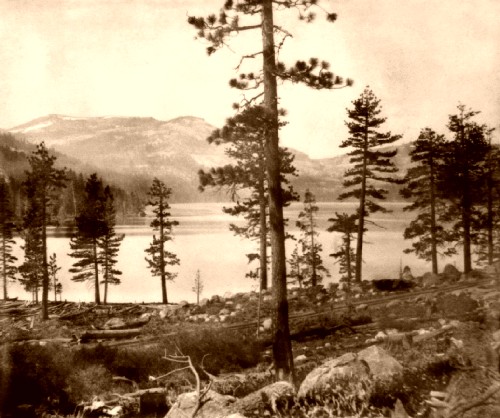
Donner Lake, 1866,
Donner Lake, 1866,
This image available for photographic prints and downloads HERE!

Shasta County - Long ago, when a detachment of soldiers were transporting an Army payroll along the road between Redding and Weaverville, California, they were attacked by Indians. While the battle ranged, one soldier had the foresight to bury the gold and marked it by burying his rifle straight up in the ground. He then joined the rest of the soldiers in the frenzied battle.   Severely wounded, he was later rescued and taken to French Gulch where he told the story of the attack and buried payroll before he died. Though the army began an immediate search, they were unable to find the rifle or the hidden gold. Many years later, two deer hunters in the vicinity found the rifle and not knowing the story, removed it and took it with them. Today, French Gulch is a sleepy little village located about 10 miles east of Lewiston, California.

Tehama County – Peter Lassen was a pioneer and land owner in California long before its Gold Rush days of 1849. Arriving in 1840, he was able to secure a 26,000-acre land grant in 1843. Located in the upper Sacramento Valley, Lassen hoped to develop his land into an empire and established the Rancho Los Bosquejo, or the "ranch of the wooded places" in 1845. In the years that followed, Lassen developed a trading post, a new settlement, vineyards, and farms to entice people to what he believed would be his new empire. However, when gold was discovered at Sutter’s Mill in Coloma, his workers and settlers abandoned him for the goldfields. Lassen’s fortunes would rise and fall over the next decade until he was murdered in 1859 while traveling to Virginia City, Nevada to prospect for silver. Afterwards, a legend began to grow that Lassen had buried thousands of dollars in gold near his home on the Rancho Los Bosquejo. Located at the confluence of Deer Creek and the Sacramento River, he was said to have hidden his gold coins in iron pots surrounding his property. Though Lassen had a lifetime of financial difficulties, the legend continues. The buried cache is thought to be in Deer Creek Canyon near Vina,California or somewhere along the Lassen Trail which follows Deer Creek.

Some twenty years after Lassen's death, a miner named Obe Leininger found a gold-flecked ledge of gold in the same area. In order to find it again, he marked the spot by burying his pick in the trunk of a nearby tree. When he returned, however, he was unable to find the tree with the pick, though he searched the area diligently. Though he and others who had heard his tale continued to search the area for years afterwards, the gold ledge was never found again. The location of the ore was said to be to between the mouth of Calf Creek and the Potato Patch campground of the U.S. Forest Service, just beyond Deer Creek.

Trinity County - In the 1862, the sheriff of Trinity County was not only responsible for upholding the law, but was also tasked with collecting taxes. On one occasion as he was traveling through the area, his saddle bag was filled with about $1,000 in gold coins and $50 gold slugs. As the sheriff and his horse were cautiously crossing a stream, the horse stumbled and the saddlebag filled with gold was dropped and washed down the creek. Though the lawman made an immediate search of the area, he was unable to find the bag. Soon, the county offered a reward of $250 for the recovery of the saddle bag, but but despite diligent search efforts, including damming up the creek, it was never found. In those early days of California, gold slugs were often minted by assayers and private mines. Today, in addition to their gold value, they have also become major collectible items, and if the treasure were to be found today, some estimate it could be worth as much as a million dollars. The creek was located near Weaverville, California.

Yuba County - During California's Gold Rush days, a prospector by the name of Bill Snyder was one of the lucky ones. Working a claim along on of the branches of Oregon Creek on a ridge behind Camptonville, he consistently brought out large quantities of gold. Just as the gold was almost exhausted, Snyder became seriously ill and knowing he needed medical attention, he buried his gold, estimated at $30,000, between 2 large pine trees in the flat area below his cabin. He then left his cabin to seek a doctor. Though the type of illness is unknown, it was evidently very serious, as he was unable to return home for over a year. Imagine his distress when he returned to the site to find his cabin and the two large pine trees gone, replaced by a sawmill that now stood in its place. Only stumps of trees remained and though he searched diligently i the area, he was never able to locate his buried gold. He later died in the county home and to this day the hidden cache has never been found.

© Kathy Weiser/Legends of America, updated September, 2010.
If you enjoy these stories please visit my website for your prospecting needs.

Saturday, March 19, 2011

Lost Treasures of Northern California

As in many places of the American West, the friction between the scores of men entering California during its Gold Rush days and the Indians was often bitter. Weary of the white men continuing to encroach upon their lands, the danger to travelers was very high when entering the California from the northeast.
As the California Trail proceeded south into the SacramentoValley on the Pit River route, wagon trains and travelers were often ambushed by the natives. Bloody Springs, at the lower end of Spring Gulch, was the scene of numerous attacks, hence its name. Smaller groups were often wiped out.

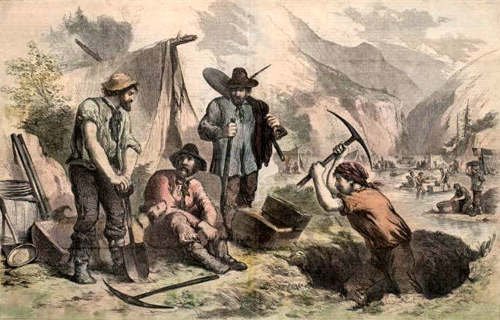
California Gold Miners
Engraving of California gold miners, John Andrew, mid 1800's.
On one such occasion an entire emigrant train was massacred by the Indians. Only one man survived to tell the story. Finally, he made his way to Fort Crook, telling of how the train was carrying approximately $60,000 in $20 gold coins. Before he made his getaway, the man witnessed the Indians competing to see who could throw the shiny disks across the Pit River Gorge. The "contest” continued until each and every one of the gold coins was either in the river or lodged into the rock walls of the gorge.
Today, an occasional gold piece is still found at Bloody Springs in Lassen County. Bloody Springs is located a few miles southeast of Pittsville above the banks of the Pit River.
From the 1850’s to the 1880’s Sierra County, California was crawling with prospectors in search of gold. The northernmost region of California's mother load, dozens of mining camps, with such names as Poverty Hill, Queen City, Port Wine and Poker Flat, sprouted up as prospectors searched for the glittering rocks in the streams of the area. By the late 1850’s hydraulic mining began in the region which continued through the 1880’s.
No doubt, during these affluent times, many a prospector and mine owner made their fortunes. But, they were not the only ones. Those storekeepers who catered to the miners’ needs also profited. One such man who gained wealth running his retail establishment was named Jerome Peyron. The storekeeper was known to have made frequent trips into the hills behind his store in Poker Flat where he buried his money.  However, when a Mexican Gang heard of Peyron’s hidden money, they converged upon his shop demanding to know its location. When the Peyron refused to tell them, he was murdered by the gang.

To this day, Peyron’s buried cache has not been found.

© Kathy Weiser/Legends of America, updated June, 2008

Tuesday, March 15, 2011

UTAH LEGENDS Winter Quarters - Hidden Loot in a Ghost Town


There’s gold in them thar hills!” was a cry a few years ago regarding Winter Quarters, a Utah ghost town and mining camp. That cry came years after Winter Quarters was abandoned and for reasonable cause. First, a little history of the town.

Coal mined at Winter Quarters was the first coal mine in Utah and was first opened by George Matson in the spring of 1875.

"When we arrived in Pleasant Valley, later the site of Winter Quarters, we started right in to survey Pleasant Valley township and later we did assessment work on the claims.


Winter Quarters, Utah, 1900
Winter Quarters, Utah in 1900, photo by
George Edward Anderson.
This image available for photographic prints and downloads HERE!
Phil Beard, John Nelson and I started No. 1 tunnel and drove the first hundred feet into the hillside. Later, thousands of tons of coal were hauled out of this entry. I helped dig from the five-foot vein, the first load of coal ever shipped out of the valley,” so said Matson in an Aug. 23, 1928 issue of The Sun newspaper, published at Price."
The high mountain ghost town in extreme northwestern Carbon County, became known as Winter Quarters because John Nelson and Abram Taylor wintered there in 1875 to hold the claim they had filed.
Two years later a group of men from Sanpete County came over the mountain to begin the town and continually work the mine. They intended to leave before winter, but an early snowstorm trapped the men. When their supplies ran out in February 1878, they the walked out to the north, eventually reaching the town of Tucker (now a ghost town and rest stop) in Spanish Fork Canyon.
When the great tonnage of coal in the mountain was known, more people began moving into the burgeoning town. As more and more coal was mined, the need for a railroad became apparent. Some of the residents got together and bought out a dry goods firm in the east and paid railroad workers with clothing and fabrics.
That old railroad bed is now a dirt road leading from the Tucker rest area on US-6 up the mountain onto what is known today as Skyline Drive and then down into Pleasant Valley. The railroad became known as the Calico Line.
May Day, 1900, started out with a clear sun shinning up the valley into the town as 303 miners headed up to the mine portal. This mine was considered one of the safest in the country and had been inspected by Gomer Thomas, state mine inspector, on March 8.

But at 10:15 a.m. everyone in the mountain town felt the ground shake. Some people thought someone had fired off an explosion to celebrate Dewey Day. Soon, the horrible truth spread through the town like wildfire. A giant explosion had occurred in the mine.

Mothers and daughters were seen hurrying toward the mine portal, "faces blanched with fear, hoping against hope that their loved ones in some way had escaped. Soon the realization came that the miners were caught – caught like rats in a trap with no chance of escape,” reported Charles Madsen in his account of the disaster.

Wasatch Store in Winter Quarters, Utah
After the mining disaster caskets broght in from Salt Lake City and Denver were unloaded at the Wasatch Store in Winter Quarters, Utah. Photo courtesy Utah State Historical Society.

When rescue and recovery teams were finally able to enter the horizontal shafts, they found "men piled in heaps, burned beyond recognition. The bodies were removed as fast as possible and the school, the church and other available buildings were requisitioned as morgues.
When the accounting was done, 104 had escaped, seven of them seriously injured, and 199 killed in the mine blast. The town was 28 years from being a total ghost town.
When Pleasant Valley Coal Company opened mines at Castle Gate, far below Pleasant Valley, it spelled the end of the long-haul operations at Winter Quarters. Production decreased steadily and in 1928 the mine was closed and the town abandoned.

For many years the buildings stood mute in that mountain valley: windows boarded shut, roof shingles slowly slipping and walls rotting into dust. The school no longer heard the sounds of children laughing and there was no need for a janitor to clean the spring-time mud from the floors.
Eventually the buildings collapsed or were torn down by scavengers and today only grass-covered foundations remain of what was Utah's first coal camp. No industrial sounds in the quiet valley today, only a bubbling stream and the clicking of mule deer hooves on the rocks. But is that all that remains?
Speculation over the years about buried gold has frequently come into conversations about the mining town.
There is no question about the miners being paid in gold and silver coins. Just three years earlier, Butch Cassidy and Elza Lay had robbed the Pleasant Valley payroll when the money arrived by train. Their loot was $7,000 in gold double eagles. They dropped $700 in silver.
Couple that payroll with the fact that there was no bank at Winter Quarters and it is easy to see how many believe some of those miners had cached gold coins among the rocks or under fence posts behind their homes on the valley side. If they had not told wives of the cache, knowledge of it died with the miners that May Day in 1900.
Some have looked over the years for lost gold in the old town site. None has ever reported finding some.
Can it be that the ghosts of those miners stand watch over buried gold double eagles?


©Chuck Zehnder, Added July, 2007

Sunday, February 27, 2011

The Lost Gold Ledge


 The Lost Gold Ledge
Unknown Gold ProspectorWhen the great gold strikes in Goldfield, Tonopah and Rawhide began to draw thousands of people to the Nevadadesert, they also drew a prospector named Tim Cody. Setting up a base camp at Stewart Springs about 15 miles from Goldyke, Cody quickly began to prospect the area. 
Before long, he was running low on supplies and decided to make a trip to Goldyke on an overcast winter’s morning. On foot, he began to make the long journey when a storm began to brew. In the blustery storm, he was soon lost and found shelter in an abandoned mine shaft. 
Spending the night in the mine, he arose to find the storm gone and the skies clear blue.  He began to climb a nearby ridge to get his bearings before continuing his journey to Goldyke. Along the way he found a rich gold vein in a quartz outcropping. Picking up some samples, Cody continued his climb to the top.
At the summit, he could clearly see Paradise Peak and Rawhide Peak to the northwest.  Making his way back down to continue his trip to Goldyke, he was soon lost again, but after some difficulty he finally made his way to the settlement. After re-supplying, he returned to his base camp and tried several times to relocate the gold laden quartz vein.
However his continued searches proved fruitless and finally he moved on.  However, three men showed up in 1949 with a map that Cody had supposedly drawn for them. The three scoured the area looking for the lost ledge, but they too, were unable to find the rich vein of gold.

Today, the legend continues. The lost ledge is said to be somewhere in the hills south of Gabbs. Perhaps, you will be the lucky prospector to find it again.


Joining the thousands of "49ers” rushing intoCalifornia were brothers, Charles and Joshua Breyfogle. Hailing from Lockhart, New York, the pair headed west with a train of saddle and draft horses and two wagons in the spring of 1849. They soon teamed up with other pioneers inColumbusOhio and continued their long journey to the California goldfields.

After many trials and tribulations through theIndian ridden plains, steep mountains, and harsh desert, they finally reached Sacramento on August, 14, 1849.

About a month later the Breyfogles began searching for their fortunes in the promising areas of Butte Creek and the Chico River. Having no success, they had moved on to the YubaRiver, some 12 miles above the California gold rush tent city of Marysville, in January, 1850. 

Nye County, Nevada
Many believe the lost Breyfogle Mine is in Nye County, Nevada.
Again disappointed, they moved upstream a month later to Goodhues, where they began to work on a new claim. This time their efforts paid off, as they began to find gold in the river bottom and along the banks above the river.

By December, 1850, Charles Breyfogle returned to New York with some $20,000, leaving his brother Joshua to work the claim. A year later, Charles returned to California, settling in Oakland where he was elected county assessor in 1854 and treasurer in 1859.  When he couldn’t account for $6,500 in county funds, he was thrown in jail. Though he was soon exonerated and released, he evidently had had his fill of politics and decided to return to prospecting.

Following the new silver strike in Nevada, he went to Virginia City where the buzz was all  about the new finds near Austin, Nevada in 1862. More stories were circulating about gold in the Big Smoky Valley and seeing opportunity, Breyfogle opened a real estate office in a hotel at the mining camp of Geneva. Unfortunately, by the time Charles arrived the Geneva veins were already dwindling and he was once again looking for opportunities.

In 1863, he heard three men at the hotel discussing a crude map. Sure that they were discussing the legendary Lost Gunsight Mine of 
Death Valley, he decided to follow them when they left the next day. Trailing them across Nevada, he caught up with them between Tonopah and Goldfield, where he was surprised to find that the men were not looking for the lost Gunsight lode, but rather were on their way to Texas to join the Confederate army. The men were on their way to join a wagon train on the Los Angelestrail and Breyfogle decided to ride with them for a couple of days.

Three days later, the men were encamped south of Ash Meadows in the Mohave Desert’sAmargosa River Valley. Laying his bedroll out apart from the others, he awoke in the middle of the night to see Indians attacking the other three men. Grabbing his bedroll and boot, he fled in the darkness.

Without provisions or weapons he wandered in the desert for several days until he finally found a spring. Resting there, he found gold in a deposit of quartz and took with him several samples, vying to return if he could ever find his way out of the desert. Heading south, he eventually came upon wagon tracks which he followed to Stump Spring in thePahrump Valley, in Nevada's eastern Mohave desert.

Deciding to wait at the spring for a wagon train to show up, he was instead found byIndians first. Taking him captive, they worked him as a slave for months. Finally a Mormon wagon train came upon the Indian village and freed him with a ransom. Taking him to a ranch at Manse Spring in southern Nevada he was cared for by the wife’s owner, Mrs. Yount. Grateful, he told the family about his gold discovery, showing them the samples he had held onto.

After Breyfogle had fully recovered he settled in AustinNevada, where he would organize search parties for the next 26 years. Concentrating on the region northeast of Death Valley, the men would search in vain, never finding that lost outcropping. But Breyfogle never stopped looking, becoming so obsessed with the search that he once said, "I shall come back a rich man or leave my bones in Death Valley." 

Through the years, many theorized as to where Breyfogle had found the gold, believing it to be located near 
Las Vegas, Salt Spring, or Daylight Pass. However, many believed that the very same rich quartz that Charles had discovered ended up becoming the Johnnie Mine, north of Pahrump, Nevada. The rich lodes of the Johnnie District were first discovered in 1891 by a man named George Montgomery who was searching for the famous Lost Breyfogle Mine. Yet others believe the mine to be in California in the Armargosa River Valley. Though the vast majority believe that Breyfogle’s find was in the Johnnie Mining District, not all researchers and hobbyists are convinced, as they continue to search for Breyfogle’s lost gold.

Armagosa River Valley
Many researchers and hobbyists believe the Lost Breyfogle Mine to yet unfound in the Armagosa River Valley ofCalifornia, photo courtesy
 University of California - Santa Barbara Department of Geography


The Johnnie District is in Nye County, in southwestern Nevada. On the north end of the Pahrump Valley, most of the placer activity was conducted in the washes below the Congress Mine, but also to the northeast of Johnnie on the west slope of the Spring Mountains, and other surrounding areas. To get there, travel south from Las Vegas on Interstate 15 to the junction of State Route 16, then follow northwest past Pahrump for approximately 70 miles to reach the Johnnie District. Here, mines and placers can be seen on both sides of the highway and on the slopes of Mount Schader and Montgomery.


© Kathy Weiser/Legends of Americaupdated October, 2010.


Saturday, January 29, 2011

More California Treasures Just Waiting To Be Found


Alameda County - With a posse on their tails in 1893, two banditsallegedly buried a cache of stolen loot near a brick kiln at Adams Point on Lake Merritt. When the lawmen caught up with the outlaws, one was killed and the other immediately arrested. The surviving outlaw died later died in prison. The ill-gotten treasure has never been found.

Contra Costa County - Dr. John Marsh, a California pioneer who was sometimes referred to as California's first American doctor, was allegedly known to bury his money near his home nestled in the foothills of Mt. Diablo.

Lake Merritt, California, from Adams Point, 1884
Lake Merritt from Adams Point, 1884, photo

Marsh was murdered in 1856 while on his way home from Martinez, without ever telling anyone of the exact location of his hidden riches. The treasure tale today alleges that Marsh had hidden a cache of some $40,000 gold coins near his home or Marsh Creek, that bears his name. Currently plans are under way to develop the location into a CaliforniaState Park.


Another, even larger treasure is said to be buried along the beaches of the county. In 1901, the Selby Smelter at Vallejo Junction was busy refining ores that were shipped from a number of neighboring mining districts.  But, one employee by the name of John Winters, was "busy” at a different task -- that of removing gold bars, one at a time from the vault, and burying them on the beach near the water’s edge. Taking an estimated $283,000 in gold, Winters was finally caught and about $130,000 of the bars were recovered. However, more than $150,000 remained lost.

Humboldt County - In July of 1928, the small post office at Willow Creek was robbed by two outlaws that escaped with some $2,800. According to the story, the bandits buried the loot in one of two places and never returned to retrieve it. The first version of its location tells of the stolen cache being buried near the Cedar Flat Bridge that crosses Trinity River about four miles upriver from Burnt Ranch. The second location has the loot hidden at some point up New River Canyon on the first ranch above the mouth of New River.

Another stolen cache, taken by an employee of the San Francisco Mint in 1894, is said to be buried in Humbolt County. The thief was later captured and sent to prison for his crime but refused to reveal the exact location of the loot. The treasure, containing some 290 pounds of gold ingots, is thought to be buried at Shelter Cove near Point Delgado.

Inyo County - Near Scotty's Castle in Death Valley, some say that a hidden cache of gold coins, amounting to as much as $200,000, was buried by Walter Scott. "Scotty," as he was more familiarly known, was a flamboyant and outrageous character, and a known swindler and prospector. Though he did not build or own the castle that bears his name, he was closely associated with the man that did.

Kings County - In 1873, the small town of Kingston, California was a stopping place on the Overland Stage route between Stockton and Visalia, California. In December of 1873,Tiburcio Vasquez and outlaw band made a bold raid, robbing the entire village and holding 39 men hostage. When an alarm was raised , the bandits dashed to their horses and began to flee. However, in the ensuing melee, three of the outlaws were shot and killed and the man carrying the stolen loot was wounded.

Kingston, California, 1879
Kingston, California is gone today but was thriving in 1870, photo
Unable to reach a horse, the injured bandit escaped on foot and made his way across the Kings River. Though theoutlaw was pursued, neither he nor the loot could be found. Years later, a skeleton was discovered in the area and was thought to have been the injured bandit, but again the ill-gotten cache remained unrecovered.

By the 1890's the town of Kingston had totally been abandoned and is completely gone today. The site of the town is now a California Historical Landmark (#270), which can be found in Kingston Park in the city of Hanford.

Marin County - Not all lost treasures of California are related to the Gold Rush. During the wild and wooly days of Prohibition, a German whiskey smuggler named Carl Hause was doing a brisk business. Hause's operations were located on Point Reyes Peninsula at the edge of Drake's Inlet just south of Inverness. The whiskey smuggler was said to have buried approximately $500,000 in gold-backed currency somewhere between Inverness and the old Heims Ranch. However, the liquor entrepreneur would not live to retrieve his ill-gotten gains as he was found shot to death in his car. The currency has never been found.


Modoc County - Though Modoc County was never known as prime mining country, a few treasure tales continue to be told in this region that is most known for its Indian lore and unparalleled scenic beauty.
In the last years of the 19th century a sheepherder picked up a heavy rock on the west slope of the South Warner Mountains. Forgetting about it for months, he finally retrieved the stone and took it to an assayer. Imagine his shock when he was told that the heavy rock was almost pure gold. He soon found an Alturas banker, who grubstaked him and the sheepherder returned to the Warner Mountains. However, try though he might, he searched relentlessly and was never able to find the source of ore again.

Another fairly well authenticated story tells of an Oregon emigrant who picked up a similar piece of rock in the 1850’s in the area of Devil's Garden. Though no mineral deposits of any amount were ever found in the area, the legend of hidden ore persists.

In the lava beds of northwest Modoc County a family was seeking refuge from a snowstorm some sixty years ago. While there, they said they found a rich copper vein in a crater of the rugged volcanic formations. Though Mr. Courtright and other prospectors returned to the area to search for the rich ore, it was never found.

During the 1860's an army scout by the name of Daniel Hoag was stationed at Fort Bidwell. While on a scouting trip into the Warner Mountains, in the area of Fandango Peak, he reportedly found a rich gold ledge. However, it was at this time that the area was in the midst of what is referred to as the Modoc Indian War. Hoag was killed in one of the battles before he was able to return to the site and the location of the ledge remains lost. Fort Bidwell, used from 1864 to 1892, is located on the Fort Bidwell Indian Reservation, where the officer's quarters continue to stand near the old post cemetery.


Nevada County - Several tales continue about the Donner Partyhaving buried their money during the time they were trapped during that terrible winter in 1846. One story tells that George Donnerallegedly buried about $10,000 in gold somewhere near Alder Creek northeast of Truckee, California. Though the cache has never been "officially" located, many believe that it was dug up and stolen afterDonner's death. Other members of the party are also said to have buried their savings in the area. This was supported when in May, 1891, a man named Edward Reynolds found a five-franc silver piece while fishing on the northeast corner of Donner Lake. A few days later, he and a friend returned to the site and found an entire sack of coins. The horde was believed to have been hidden by Elizabeth Graves.

San Luis Obispo County - There are numerous caves located through San Luis Obispo County that provided great cover for outlawsduring California's Wild West days. Near Avila Beach, a group ofbandits were said to have made one of these caves their hiding place where they hid much of there stolen cache. No additional information is available on the exact location of the cave.


Donner Lake, 1866,
Donner Lake, 1866,
This image available for photographic prints and downloads HERE!

Shasta County - Long ago, when a detachment of soldiers were transporting an Army payroll along the road between Redding and Weaverville, California, they were attacked by Indians. While the battle ranged, one soldier had the foresight to bury the gold and marked it by burying his rifle straight up in the ground. He then joined the rest of the soldiers in the frenzied battle.   Severely wounded, he was later rescued and taken to French Gulch where he told the story of the attack and buried payroll before he died. Though the army began an immediate search, they were unable to find the rifle or the hidden gold. Many years later, two deer hunters in the vicinity found the rifle and not knowing the story, removed it and took it with them. Today, French Gulch is a sleepy little village located about 10 miles east of Lewiston, California.

Tehama County – Peter Lassen was a pioneer and land owner in California long before its Gold Rush days of 1849. Arriving in 1840, he was able to secure a 26,000-acre land grant in 1843. Located in the upper Sacramento Valley, Lassen hoped to develop his land into an empire and established the Rancho Los Bosquejo, or the "ranch of the wooded places" in 1845. In the years that followed, Lassen developed a trading post, a new settlement, vineyards, and farms to entice people to what he believed would be his new empire. However, when gold was discovered at Sutter’s Mill in Coloma, his workers and settlers abandoned him for the goldfields. Lassen’s fortunes would rise and fall over the next decade until he was murdered in 1859 while traveling to Virginia City, Nevada to prospect for silver. Afterwards, a legend began to grow that Lassen had buried thousands of dollars in gold near his home on the Rancho Los Bosquejo. Located at the confluence of Deer Creek and the Sacramento River, he was said to have hidden his gold coins in iron pots surrounding his property. Though Lassen had a lifetime of financial difficulties, the legend continues. The buried cache is thought to be in Deer Creek Canyon near Vina,California or somewhere along the Lassen Trail which follows Deer Creek.

Some twenty years after Lassen's death, a miner named Obe Leininger found a gold-flecked ledge of gold in the same area. In order to find it again, he marked the spot by burying his pick in the trunk of a nearby tree. When he returned, however, he was unable to find the tree with the pick, though he searched the area diligently. Though he and others who had heard his tale continued to search the area for years afterwards, the gold ledge was never found again. The location of the ore was said to be to between the mouth of Calf Creek and the Potato Patch campground of the U.S. Forest Service, just beyond Deer Creek.

Trinity County - In the 1862, the sheriff of Trinity County was not only responsible for upholding the law, but was also tasked with collecting taxes. On one occasion as he was traveling through the area, his saddle bag was filled with about $1,000 in gold coins and $50 gold slugs. As the sheriff and his horse were cautiously crossing a stream, the horse stumbled and the saddlebag filled with gold was dropped and washed down the creek. Though the lawman made an immediate search of the area, he was unable to find the bag. Soon, the county offered a reward of $250 for the recovery of the saddle bag, but but despite diligent search efforts, including damming up the creek, it was never found. In those early days of California, gold slugs were often minted by assayers and private mines. Today, in addition to their gold value, they have also become major collectible items, and if the treasure were to be found today, some estimate it could be worth as much as a million dollars. The creek was located near Weaverville, California.

Yuba County - During California's Gold Rush days, a prospector by the name of Bill Snyder was one of the lucky ones. Working a claim along on of the branches of Oregon Creek on a ridge behind Camptonville, he consistently brought out large quantities of gold. Just as the gold was almost exhausted, Snyder became seriously ill and knowing he needed medical attention, he buried his gold, estimated at $30,000, between 2 large pine trees in the flat area below his cabin. He then left his cabin to seek a doctor. Though the type of illness is unknown, it was evidently very serious, as he was unable to return home for over a year. Imagine his distress when he returned to the site to find his cabin and the two large pine trees gone, replaced by a sawmill that now stood in its place. Only stumps of trees remained and though he searched diligently i the area, he was never able to locate his buried gold. He later died in the county home and to this day the hidden cache has never been found.

© Kathy Weiser/Legends of America, updated September, 2010.

Cute video watch it !

GoAnimate.com: wealth 4 all dinner by mrhall909

Like it? Create your own at GoAnimate.com. It's free and fun!